Success Stories
Success Stories
|
|
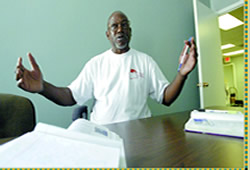
U.V. Irby, who was raised as a middle child in a family of 13 in Mississippi, never had much of an opportunity to learn how to read when he was growing up. As the oldest child in the house
when his mother became ill and his father lost a leg, Irby had to quit school with only a 9th grade education to work on a plantation to help make ends meet, earning a mere $21 per week
“I took care of my family, and I did it with a smile, ” he said. Irby married young, at age16, and fathered eight children along the way. He worked in construction most of his adult life, using
his physical strength working strenuous jobs to support and educate his children. His older children have completed high school, gone to college and enjoy successful careers, and the
younger children are following in their footsteps. That is quite an accomplishment for anyone under those circumstances, but even more so for a man who never learned to read. “I promised
I would get my kids an education. Me, I was always on the back burner. I said, ‘One day, I’m going to get off the back burner and I’m coming up front. I’m going to get my
education regardless of what it takes.’ I’m at that point now,” said Irby. Irby, like many in the U.S., has struggled with literacy, the ability to read and write, most of
his life. In Wayne County alone, an estimated 36 percent of residents 16 and older are at or below the lowest reading level. The Macomb County estimate is at
15 percent. In Oakland County, it is slightly lower. The statistics are staggering, with many of these individuals not having the basic skills that are taught in early
elementary grades. They cannot read basic things like street signs, directions on prescription bottles and packaged food labels. They cannot read a simple
story to a child. The ability of these individuals to earn a decent living for themselves and their families is a never-ending struggle. Nearly half of the adults at
this level live in poverty. The impact of these statistics, say experts, is compounded by reports that parental involvement in school-related activities, a vital part
of a child’s education, has diminished. Irby and his youngest child, Andre, 9, are learning to read together.“Kids are coming up short because the parents are
coming up short,” he said. “We don’t know how to teach them. I’m not telling my son, ‘You can read.’ I’m saying ‘We can read’ and ‘We have to study.’” Irby
began his long journey toward literacy on Aug. 7, 1999, when, at the age of 58, he walked into the Detroit offices of the Literacy Volunteers of America (LVA), a
national organization dedicated to helping people acquire literacy skills. “My reading level when I started here was nothing,” he said. “I could read nothing, not
one thing.” How did Irby get by for so many years without being able to read? Ingenuity. Cleverness. Necessity. When he had to fill out an application for
work, he would always ask to take it with him, which enabled him to have someone else fill it out. “That usually worked,” Irby said. He also carried a small
tape recorder in his shirt pocket at all times. On-the-job, verbal instructions could be secretly recorded. Written instructions were taken home, where one of
his children would read them aloud as he recorded. Irby’s life has improved considerably since he began working with his LVA tutor. After three years of hard
work, he is definitely making progress. “I can pick up a book, newspaper or magazine and make out not all, but most of the words,” he said. “I can read
passages in my Bible now. Reading is like being born again.” Margaret Williamson, executive director of LVA-Detroit, said, “What reading does is empower a
person. Without the ability to process information, a person is really disadvantaged in today’s society, from doing a simple thing such as making a grocery list to
something more complex, like using an ATM machine.” Throughout her years of working with people who have learned to read, Williamson has noticed a
tremendous increase in self-confidence. “They have the ability to research information and make their own decisions, and not rely on information passed on by
someone else,” she said. “They take joy in being able to read to their children and grandchildren, in being able to balance their checkbook and read a utility
bill.” Adult literacy programs are focused on helping individuals learn to read and write, which leads to other benefits such as economic opportunity, personal
freedom and dignity. Many programs are also focused on preparing people for today’s fast-paced world requiring communication, technology and problem-
solving skills, which are important for gaining meaningful employment. Irby hopes that his willingness to go public with his personal struggle will help others
come forward and ask for help. “A lot of people stay in the closet and hide and won’t come out, won’t tell the truth, ” he said. “I did what I did to myself. I was
being careless and didn’t care about myself. I neglected myself. I wasn’t interested in one thing that I was supposed
to be learning. Everybody blames everybody but themselves. I blame myself. I had the opportunity to do the things I needed to do, but I didn’t do it.” Irby’s
ultimate goal is to earn his GED, but he admits that day is a long way off. “I’m going to apply myself every day. Learning to read is like a food you eat,
” U.V. Irby said. “It fills you up because you’re excited, you’re hungry for it and you’re tasting it. I have a lot to be thankful for.”
Welcome

Facing Literacy

Target Literacy

We Must Promote Literacy